Mansbach Lab Open Positions
We have no open positions at this time; however, we will very likely be recruiting 1-2 students for Winter or Fall 2027. Please see below for projects that will be opening soon!
Looking for Graduate Students Interested in Generative and Reinforcement Learning for Interpretable Peptide Design
We have one open position in the Mansbach Lab in the Department of Physics at Concordia University for 2027 (January or September). There will be an associated international fee waiver and stipend for highly qualified students (there may still be regional fees associated with tuition). 1
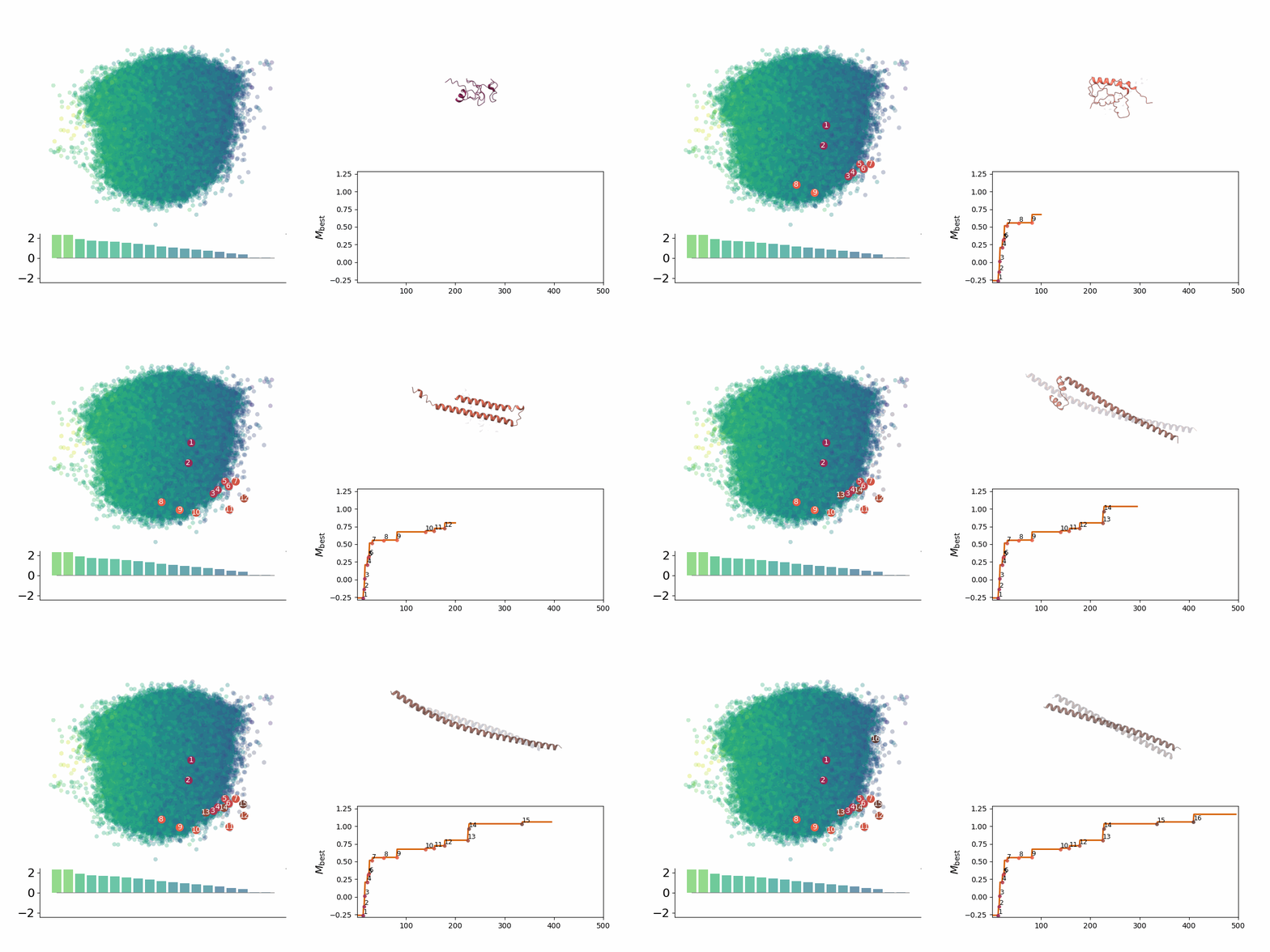
Scientific Background: Peptides are short proteins that carry out many different functions in an organism; as such, they are biocompatible molecules that form excellent candidates for many therapeutic and biomaterials applications. Generative deep learning has shown significant promise in biomolecular design scenarios, but it suffers from lack of interpretability in general and data sparsity in many peptide-specific scenarios. We are looking for a student interested in developing and using techniques from explainable deep learning and traditional machine learning to improve pipelines for peptide design. There is an option for a focus on either therapeutics design, in particular antimicrobial peptide design, or biomaterials design, in particular design of aggregating peptides with particular supramolecular architectures.
Desired Qualifications: I am committed to improving equity, diversity, and inclusion in physics and therefore I particularly encourage students from traditionally minoritized groups in STEM to apply to my lab. In addition, if you aren’t sure if you meet the technical qualifications but you’re very interested, please feel free to contact me and ask!
We are looking for a highly-motivated graduate student candidate interested in theoretical and computational biophysics, with a focus on ethical and rigorous machine learning techniques grounded in biophysical understanding. Physics, Biophysics, Chemistry, or Computer Science BA or BS (or MSc) is preferred, but we would also welcome other fields if the match is good. Must have strong programming skills. Previous experience with Python, Pytorch, or Scikit-learn is a plus, as is a strong skepticism of computers.
If you are interested in applying or finding out more, please email me at re.mansbach@concordia.ca with the subject heading “Graduate Student Candidate for Deep Learning Peptide Model.”
1 : Note for students unfamiliar with the Canadian graduate school system: generally, you need a MSc to advance to the PhD, although fast-tracking is possible if we can make a strong case for it. I’m happy to take someone for a MSc and commit to sponsoring them on through the PhD; I’m also happy to take students who solely want a MSc. And I will take MSc students looking to move onto the PhD directly.
Looking for Graduate Students Interested in Biophysical Understanding and Design of Beta Sheeting-Forming Antimicrobial Peptides
We have one open position in the Mansbach Lab in the Department of Physics at Concordia University for 2027 (January or September). There will be an associated international fee waiver and stipend for highly qualified students (there may still be regional fees associated with tuition).2
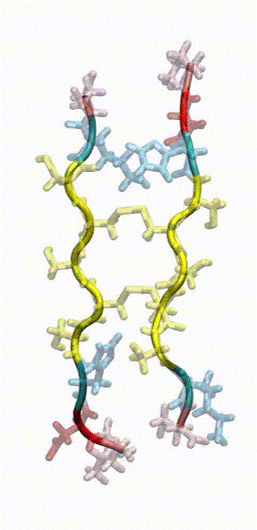
Scientific Background: Antibiotic resistance is a growing threat to global public health in which bacteria stop being treatable by conventional antibiotics like penicillin. One way to combat it is by developing new treatments that either kill bacteria or mitigate their toxic effects without incurring a rapid build-up of resistance. In my lab, we study a unique beta sheet-forming peptide called GL13K, a fragment derived from a protein in human saliva, which can destroy the cell walls of many types of bacteria and also demonstrates a protective effect against the Gram negative bacterial endotoxin lipopolysaccharide. The desirable properties of this peptide depend strongly on the local environment, including the local pH. Furthermore, it is not known how this peptide confers protection against LPS. We are looking for a student interested in employing molecular dynamics simulations and multi-scale modeling to better characterize GL13K and its interactions with bacterial cell membranes and with LPS.


Desired Qualifications: I am committed to improving equity, diversity, and inclusion in physics and therefore I particularly encourage students from traditionally minoritized groups in STEM to apply to my lab. In addition, if you aren’t sure if you meet the technical qualifications but you’re very interested, please feel free to contact me and ask!
We are looking for a highly-motivated graduate student candidate interested in theoretical and computational biophysics, with an emphasis on model development and deriving biochemical and biophysical insights and design rules. Physics, Biophysics, Chemistry, or Biochemistry BA or BS (or MSc) is preferred, but we would welcome other fields if the match is good. Previous experience in computational techniques, particularly molecular dynamics simulation, is a plus, as is previous experience with Python.
2 : Note for students unfamiliar with the Canadian graduate school system: generally, you need a MSc to advance to the PhD, although fast-tracking is possible if we can make a strong case for it. I’m happy to take someone for a MSc and commit to sponsoring them on through the PhD; I’m also happy to take students who solely want a MSc. And I will take MSc students looking to move onto the PhD directly.
Looking for Graduate Students Interested in Multi-Scale Modeling for Design of Mucus-Inspired Biomaterials
We have one opening for a position in the Mansbach Lab in the Physics Department at Concordia University for 2027 (January or September). There will be an associated stipend for highly qualified students (there may still be regional fees associated with tuition). 3
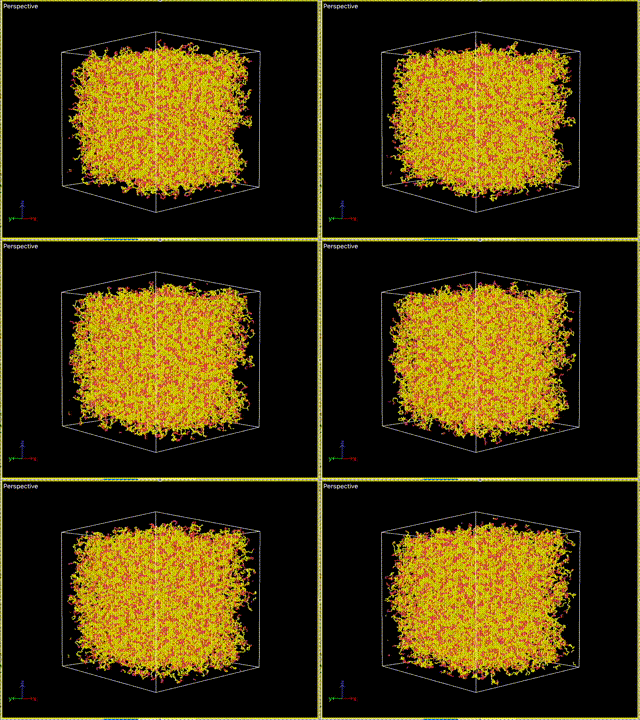
Scientific Background: Our bodies are covered in snot, and that’s not a bad thing! Mucus, which is a complex hydrogel primarily made up of large proteins called mucins, forms the first barrier to entry in our eyes, mouth, lungs, and gut. It is a remarkably useful, multifunctional biological assembly, that has demonstrated potential for many biomedical applications, particularly in the area of wound healing. Due to its complexity, however, it can be difficult to create and control. We are looking for a student interested in developing a multi-scale model of a mucus-mimicking biopolymer system that will allow us insight into how to design mucus-like biomaterials.
Desired Qualifications: I am committed to improving equity, diversity, and inclusion in physics and therefore I particularly encourage students from traditionally minoritized groups in STEM to apply to my lab. In addition, if you aren’t sure if you meet the technical qualifications but you’re very interested, please feel free to contact me and ask! We are looking for a highly-motivated graduate student candidate interested in theoretical and computational biophysics, with an emphasis on model development and biomaterials design. Physics, Biophysics, Chemistry, or Biochemistry BA or BS (or MSc) is preferred, but we would welcome other fields if the match is good. Previous experience in computational techniques, particularly molecular dynamics simulation, is a plus, as is previous experience with Python.
3 : Note for students unfamiliar with the Canadian graduate school system: generally, you need a MSc to advance to the PhD, although fast-tracking is possible if we can make a strong case for it. I’m happy to take someone for a MSc and commit to sponsoring them on through the PhD; I’m also happy to take students who solely want a MSc. And I will take MSc students looking to move onto the PhD directly.